
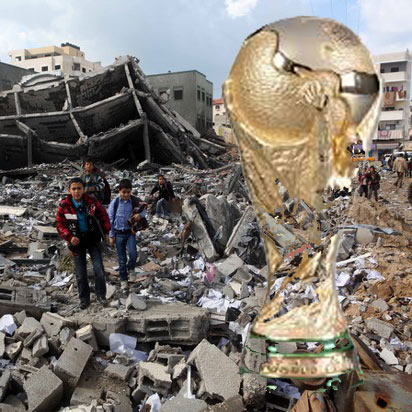
Soccer shocker

coccompWhile Germany dismantled Brazil on the futebol grass, Israel demolished the houses of Palestinian families in Gaza — and my attention, like much of the world’s, was focused on the soccer game.  In the article below, originally published by Al Jazeera English, Prof. Hamid Dabashi of Columbia University in New York asks why is that.  Excellent question.  By way of a P.S. I append a short excerpt about soccer in Israel from Max Blumenthal’s book Goliath: Life and Loathing in Greater Israel, and a link to a news story about Israeli army men deliberately shooting Palestinian soccer players in the foot.

—-

Hamid Dabashi:

Take a look at the headlines. Iraq is on the verge of self-destruction. An international gang of mercenaries has just established a “caliphate” in Iraq and Syria. Ukraine is in deep turmoil. In Egypt, a military coup has just staged a ridiculous election and jailed journalists to hide its atrocities. In Afghanistan, yet another presidential election is publicly challenged. In Palestine, Israelis are again out on a rampage, killing innocent people under their military occupation, while African immigrants to the Jewish state have appealed to the UN to save them from abuse. In the US, the memo justifying drone killing has been released, with the habitual legalese gobbledygook.

All these exceptionally important – and even world-historic – events happened at a time when people around the world were far more interested in the World Cup than in political news. It brings to mind an old cartoon in which US military advisors tell US President George W Bush: “We could invade Iran right now and nobody would notice.”

So, why is that?

Brazil is in deep financial crisis. FIFA is a notoriously corrupt institution. Qatar is under the spotlight for its guest labour practices as it prepares to host the 2022 World Cup. The scandal of trafficked players, particularly from Africa to Europe, is common knowledge.

“They come to Europe to play for AC Milan or Paris St-Germain,” as one Guardian article put it, “but the reality for many talented young African footballers, children not much older than nine, is that they will find themselves selling fake handbags on the streets.”

These and many other scandals have hit soccer enthusiasts, and yet the World Cup goes on triumphantly. Why?

A level playing field

The soccer (or more accurately “football” as the whole world, save for the United States, knows it) we passionately love and follow closely during the World Cup is a magnificent spectacle set on the world stage, and with it, for a fleeting moment, we celebrate the possibility of a fair, just and, level playing field, where rich and poor nations, weak and powerful, famous and unknown, share a reasonable chance to take a swing at fate.

The World Cup is a drama in which the actors, the spectacle, and the spectators – present and absent – around the globe are all, in one passing moment, part of a fair, free, and common play. We become the world in one act of universal ritual that overwhelms and overshadows all the major world religions…

It is here, on this spectacular stage, that the Sermon on the Mount becomes manifest and the blessed might indeed become the meek, for they might (just might) inherit the earth by winning the World Cup. When the referee blows that very first whistle of that very first match of the World Cup of any given year, almost anything is possible – Iran might defeat the US, Nigeria, Russia, Ghana, or Germany, and there is a bizarre cognitive dissonance between what these national signifiers mean on the world political scene and on the football field.

The World Cup is a drama in which the actors, the spectacle, and the spectators – present and absent – around the globe are all, in one passing moment, part of fair, free, and common play. We become the world in one act of universal ritual that overwhelms and overshadows all the major world religions – Judaism, Christianity, Islam, Hinduism, and Buddhism – put together. Christian rituals might be meaningless to Jews or Muslims, as Islamic forms of piety seem strange to the whole non-Muslim world. But not football the way FIFA has regulated it.

Ask any kid from Palestine to Portugal, India to Ghana: the whole world knows the rules, performs the rituals, suffers the consequences or enjoys the results more readily than they fathom or fear any promise or admonition of heaven or hell in any soteriology. The names of top strikers like Lionel Messi (Argentina), Robin van Persie (Netherlands), or Luis Suarez (Uruguay), are known better than the saints of any religion.

The results of matches, however heartbreaking, are accepted begrudgingly in the face of the fierce urgency of the next game. The host country was almost ousted when playing against Chile. It is as if the fate of our humanity is decided on that very last goal of that very last game. All the rules are known, actors knowable, agency earned, fame deserved. Precious few, except the aficionado, know the players of various teams before the games start, but by the time the games are over, we know and love or disregard them more passionately than Biblical or Quranic prophets. Right now, there are more people around the world who know the details of Uruguay striker Luis Suarez biting Italy defender Giorgio Chiellini than can recount any Biblical account.

There is a satisfying immediacy and justice to football that the world of politics sorely lacks. In world politics, a war criminal like Dick Cheney or Tony Blair is instrumental in destroying an entire nation-state and all its institutions, and yet gets away with it. Not in the World Cup. One nasty move and one is first yellow-, then red-carded, at which point he is out of the game. Here in the real world, Dick Cheney or Tony Blair actually get to write articles for newspapers and magazines denouncing the current US president for not having finished the destruction of Baghdad the way they had intended it.

Politics intrude

Politics, though, intrude on football like an obnoxious and unwanted guest. Soon after the 1-0 victory of Argentina over Iran, the Argentinian striker Lionel Messi, who had scored the only goal against Iran, evidently received a supportive tweet from some account purporting to belong to the Islamic State of Iraq and Syria (ISIS), congratulating him on his goal and inviting him to join the murderous organisation, giving him the honorific title of “Abu Mehdaf the Argentinian”, and appointing him “a prince over South America and its environs”. Sounding more like a nauseating joke than real, the tweet actually received a full report from the Washington Post. I still believe it to be a joke – a sick joke.

Messi was not the only person at the receiving end of an unwanted tweet. Football-crazy druglord Fernando Sanchez Arellano was also “busted while watching World Cup”. According to reports, “Arellano, the leader of the once-mighty Arellano Felix drug cartel which inspired the Hollywood movie Traffic, was detained in the border city of Tijuana earlier this week. The 42-year-old boss, known as ‘The Engineer’, was totally absorbed watching Mexico playing the last match of the group stage against Croatia, when security forces walked onto the premises and arrested him.”

Soccer is politics as we wish it were: fair, fine, furious, just, and beautiful. We cheer our favourite teams because they play on a level playing field, in the broad daylight of history, for the whole world to watch, with the naked power and the visible audacity that have nowhere to hide, no secret to conceal, no treachery to harbour.

We know the fault lines of football before we get to the World Cup, but for a fleeting moment we blink and open our eyes – wide shut and open – upon a mythical stage where life can be fair and fine, so we can go back to the wretched world of politics and imagine our purposes anew.

Hamid Dabashi is the Hagop Kevorkian Professor of Iranian Studies and Comparative Literature at Columbia University in New York.

The views expressed in this article are the author’s own and do not necessarily reflect Al Jazeera’s editorial policy.

—————-

GoliathMax Blumenthal:

Named for Jerusalem’s first Israeli mayor, Teddy Kollek, Teddy Stadium is
a favorite venue for young Israeli men seeking to ventilate their pent-up
passions. They pour in from all around Israel to root for the Beitar
Jerusalem football club. The soccer team was named after the world right wing
Zionist youth movement founded by Ze’ev Jabotinsky. Its matches also
serve as a forum for the neo-fascist “Ultra” group known as La Familia. Beitar Jerusalem has counted Yisrael Beiteinu’s Avigdor Lieberman among its greatest fans, binding him with his far right enthusiasts.
Back at Teddy Stadium, fans let out the routine “Death to Arabs!” chant
after Beitar scored goals and unfurled gigantic banners displaying the
symbol of Kach, the banned terrorist group founded by Rabbi Meir Kahane,
who advocated the creation of a Arabrein theocracy in the West Bank.
According to Amir Ben-Porat, a Ben Gurion University professor of
behavioral sciences and leading expert on racism in Israeli society, “In the
late 1990S and onwards, ‘Death to the Arabs’ became a common chant in
almost every football stadium in Israel.” Ben-Porat noted that because of the
prominent role football occupied in Israeli popular culture, “This chant is
heard far beyond the stadium.”
When Salim Tuama, a Palestinian citizen of Israel who plays on the
Israeli national football team, appeared on the pitch at Teddy Stadium,
Beitar fans sang, “What is Salim doing here, I don’t know .. .. Tuama, this is
the Land of Israel. Tuama, this is the state of the Jews. I hate you Salim
Tuama! I hate all the Arabs!” When Toto Tamuz, the Nigerian-born striker
for the fierce Beitar rival Hapoel Tel Aviv, makes his way from the locker
room to the field at Teddy Stadium, Beitar fans pelt him with bananas as
though he’s a monkey, heckle him with racist chants, and sing what has
become a traditional team song: “Give Toto a banana!” During a close match
in November 2012, Tamuz put his index finger up to his lips to silence the
crowd after he scored a goal. Though he had weathered racists taunts
throughout the entire game, the Israeli referee ejected him on the grounds of
“provoking the crowd.”  […]

While Beitar fans are usually content to display their hatred for Arabs in
the form of chants, Beitar matches have occasionally transformed into
scenes of mob violence against Arabs. In February 2012, after Beitar lost to
Sakhnin, an all-Arab team from Northern Israel, bitter Beitar fans relieved
their humiliation with a mass rampage against Sakhnin’s players. After
attacking the team’s buses with stones, smashing windows, and wounding
some players, the Jerusalem police belatedly arrived to drive away the
rioters and make a few token arrests.

A month later, the rioting poured into the streets outside Teddy
Stadium, when hundreds of teenaged Beitar fans burst into West
Jerusalem’s Malcha Mall, crazed and shirtless after a dramatic victOly over
the Tel Aviv club Bnei Yehuda. Inside the mall’s food court, they attacked
Arab cleaning personnel, spat on a group of Arab women workers, and
chanted (what else?) “Death to Arabs!” Ha’aretz called the incident, “one of
Jerusalem’s biggest-ever ethnic clashes.” Though the cleaners momentarily
chased assailants away with broom handles, the security camera video
revealed that the melee hardly comprised a “clash.” A member of the mall’s
cleaning crew, Mohammed Yusuf, offered a more appropriate description:
“It was a mass lynching attempt.”

(Blumenthal, Goliath, pp. 447-449)  

———-

20147710225466734_20Dave Zirin, in The Nation, March 3, 2014:

Their names are Jawhar Nasser Jawhar, 19, and Adam Abd al-Raouf Halabiya, 17. They were once soccer players in the West Bank. Now they are never going to play sports again. Jawhar and Adam were on their way home from a training session in the Faisal al-Husseini Stadium on January 31 when Israeli forces fired upon them as they approached a checkpoint. After being shot repeatedly, they were mauled by checkpoint dogs and then beaten. Ten bullets were put into Jawhar’s feet. Adam took one bullet in each foot. After being transferred from a hospital in Ramallah to King Hussein Medical Center in Amman, they received the news that soccer would no longer be a part of their futures. (Israel’s border patrol maintains that the two young men were about to throw a bomb.)

This is only the latest instance of the targeting of Palestinian soccer players by the Israeli army and security forces. Death, injury or imprisonment has been a reality for several members of the Palestinian national team over the last five years. Just imagine if members of Spain’s top-flight World Cup team had been jailed, shot or killed by another country and imagine the international media outrage that would ensue. Imagine if prospective youth players for Brazil were shot in the feet by the military of another nation. But, tragically, these events along the checkpoints have received little attention on the sports page or beyond.

Read full article


One or two big grabbers

big grabbersHanding the world over to future generations is a transaction without reciprocity.  It violates a basic principle of contract law, which is fundamental to a market economy.  So if the handover to the future is governed by the market, the present generation will grab all it can and leave nothing for its descendants.  That’s the general theory in the abstract.  However, a team of game theorists at Harvard led by Martin Nowak have demonstrated that, as a rule, it’s only one or two big grabbers who pre-empt the resources meant for the future.  If a mechanism is put in place to curb the big grabbers, then resources can be successfully passed on to following generations, even to the fourteenth iteration.

A short YouTube video produced by Nature magazine, the international weekly journal of science, visualizes the research results.  Here it is, for what it may be worth. All relevance of the findings to our current political economic realities is in the eye of the beholder.


First week with an EV: Charging into the future

A Leaf charging

A Leaf charging

When the time came to sell my gas-guzzling Prius and switch to an EV, my main question was, can it get me to Limantour Beach and back?  Limantour Beach, one of the jewels of the Point Reyes National Seashore, is exactly 50 miles from my home in Berkeley.  The advertised range of all of the sub-Tesla electric vehicles on the market today is around 80 miles.  Unless there was a charger in the town of Pt. Reyes Station, I could get there but not back.  No deal.

That all changed in January this year when news came that an EV charger opened in Pt. Reyes Station, just a moment’s walk from the Bovine Bakery with its chocolate-chocolate-cherry cookies.  And it was not just any EV charging station, but a Level 3, also known as a DC Quick Charge.

As I learned in doing my pre-buy research, there are three charge levels for electric vehicles. Level 1 plugs into standard household current at 110 volts and does a trickle charge.  That takes 21 hours with the Leaf, more or less the same for other similarly equipped EVs.  Level 2 runs off 220 volts, also a standard household voltage but usually reserved for heavy duty appliances like electric clothes dryers and ranges.  With Level 2, the Leaf charges from 0 to 100 per cent in about 4-5 hours.  That’s plenty for overnight charging at home.

But a Level 2 charging station wouldn’t work for my Limantour Beach outings.  I do like a leisurely lunch at the Station House Cafe and then to grab one of those amazing cookies at the Bovine, but stretching that into several hours wasn’t in the plan.   Enter Level 3.

A Level 3 or Quick Charge station takes the Leaf from 0 to 80 per cent charged in less than half an hour.  You can go to 100 per cent in another half hour (the rate of charge slows as you approach a full battery) but the extra 20 per cent wouldn’t be necessary for me to get adequate range.

Level 3 is a game changer for EVs.  Many a time I’ve spent half an hour gassing up a car.  There’s cleaning the windshield, the restroom visit, then a cup of coffee, a snack, a few minutes to stretch the legs, and 30 minutes is gone.  I can imagine Level 3 charging stations arranged like a sow’s teats around a Peet’s, with EV drivers inside meeting and chatting about their cars and journeys over a java while the chargers outside hum and the charging lights blink.  When the charging is done, the car and/or the charging service sends you a text message, and off you go.  New batteries now being developed in Japan will take the charge time down to 12 minutes.

Level 3 is also a main reason why I bought a Leaf instead of the Fiat 500e.  The electric Fiat is a lot of fun to drive.  Very nimble, quick, sporty, nicely equipped, with a temperature-controlled battery system that’s state of the art.  But the Fiat doesn’t have a Level 3 charging socket, and no way to retrofit one.  The Leaf has it.

This past Friday, I set out in my fully home-charged Leaf for Pt. Reyes on a test drive.  The onboard computer estimated my range at 81 miles.  Those estimates are based on past driving behavior.  Since this was a new car (an unsold 2013 model offered at a very attractive price) there wasn’t much history for the computer to work with.  By the time I was five miles from home, the estimated range had dropped by ten miles.  I experienced my first pangs of range anxiety.  At 10 miles out, the estimated range was down 16 miles, still worrisome but the ratio was leveling out a bit.

My usual route to Pt Reyes takes me via Lucas Valley Road.  This includes a twisty climb up to the crest of the Loma Alta ridge..  I wasn’t worried about the Leaf’s power to make it up the hill.  The current crop of EVs are long past the golf cart days.  The electric motors have awesome torque.  An EV can beat almost any gas car from a stop light to the far side of the intersection and into the lane it wants.  The Leaf had no problem at all with the Loma Alta hill, and its low center of gravity (thanks to the battery) practically eliminated lean-out in the corners.  All that power also took its toll on the battery.  By the time I got to Big Rock at the crest of the ridge, the battery was at 70 per cent of capacity.

But as I rolled down the other side, the Leaf’s motor switched into generator mode, and both the battery capacity and the estimated range went up again.  And so it went, over hill and dale, up and down.  I pulled up at the EV charging station in the parking lot at the corner of 4th and B Streets in Pt Reyes Station exactly an hour after departure, with 40 miles showing on the odometer and 53 per cent showing on the battery.  The initial range estimate of 81 miles hadn’t been far off, after all.  If I had to, I could get back home from here without recharging.

As it turned out, I almost had to do that.  The Level 3 charging station — it looks sort of like a tall, slender gas pump — was vacant and available.  I took hold of the cable and plugged it into the appropriate port in front of the car.  I turned off the car’s charging timer, as required.  Then I tried to get the charging station to start charging.  No dice.  The charger’s touch screen would go so far and then freeze or crash.

The charger could also be activated, theoretically, by a smartphone app.  I had already downloaded the app and entered my credit card number into it.  I pushed all the required buttons to start charging, but nothing happened.  The charger didn’t respond.

Luckily the charger displayed a phone number to call.  I dialed and a real person answered.  He tried to get the charger started remotely via the company network.  He had no better luck than I had.  He felt that probably the charger needed to be power cycled.  He directed me to a big circuit breaker box on the outside wall of the building near the charger, and had me pull the main switch lever down to off, wait a few seconds, then back up to the on position.  Slowly the screen on the charger unit went through its rebooting cycle and came up again.  The service tech on the phone tried go get it started again via his network.  No luck.  I tried again via my smartphone app.  Nope.  I hung up.

Just then another Leaf owner, a grizzled and sunburned local, drove up and parked in the other slot of the charging station, the one with a Level 2 charging device.  I shared my woes, and he advised that such problems were common with this Level 3 unit.  However, he pointed out, the headquarters of the company that owned the charging station were located just a step or two behind the charging unit.  The door was locked and nobody was in, but he thought someone might be in later.

I parked my car nearby and headed to the Station House Cafe for lunch.  When I came back to the charging station, an older blue Leaf was parked in the Level 3 slot but was not plugged in.  As I inspected the car looking for its owner to complain of this breach of etiquette, the door to the company office opened and a man came out and identified himself as the car owner.  I told him my tale of frustration.  He assured me that he could help.  He was Richard Sachen, the founder and CEO of the company that built and owned this charging station.

Sachen took me inside the office, a sparsely furnished space with a U-shaped set of work tables and a giant Apple monitor screen on one of them, and tried to get the charger working via network.  He couldn’t get it going, either.  He explained that he had an intern helping with the programming and would look into the problem.  However, as a last resort, Sachen used his own RFID card on the charging unit, and then, finally, the charger responded and the juice flowed into my Leaf.

Sachen’s system (it’s called SunTrail and is part of the Greenlots chain) uses RFID cards to identify the account owner at the charging stations.  The other charging chains, I soon found out, use RFID cards of their own.  The cards are a bit thicker than credit cards but less than half the length.  You don’t slide them into a slot, you wave them in front of a screen.  They’re made to be carried on key chains.

I didn’t yet have an RFID card for SunTrail.  I had applied for one online but it hadn’t come yet in the mail.  Sachen personally issued me one, but explained that it wouldn’t work for a while until the central computer was updated.  While my Leaf was charging on his personal account, we chatted.

Sachen’s plan is to install charging stations on major scenic routes such as Highway One.  He is targeting the tourism market.  He wants to make it feasible for environmentally conscious people to take their EVs on sightseeing trips.  The electric energy at his Point Reyes charging station comes from 100 per cent Marin County renewable sources, he says.

Building a Level 3 charging station is not cheap.  The power company at this location only supplies 220 volts.  He pointed to a transformer box he had to buy, about the size of a small refrigerator, that stepped up the line voltage to the 480 that Level 3 requires.  The charging unit then converts the 480 AC to the 480 DC that the car’s traction battery runs on.  He also had to upgrade the pavement under and around the charging station for ADA and local code compliance.  Fortunately one of the EV manufacturers (he wouldn’t say which one) helped out with a chunky subsidy toward the electrical equipment.

From Pt. Reyes, my next destination was Santa Rosa, a distance of 36 miles and well within the car’s range after recharging.  My plan was to get another Level 3 charge at the Nissan dealer there.  The Nissan dealer at the Hilltop Mall Auto Plaza in Richmond where I bought the car has a Level 3 charger in the back of the building where charging is free, and it is open until 8 pm.  I had phoned the dealer in Santa Rosa to confirm that they also had a Level 3 charger.  They had.  But I forgot to ask when they closed.  I arrived at the Santa Rosa Nissan dealership at ten minutes after 7 pm  to find the main driveway gated and locked and all other entries blocked.  Oops!

The Leaf’s navigation system shows all available local recharging stations on its map.  Various smartphone apps do the same.  There are three dozen of them scattered around downtown Santa Rosa.  All of them are Level 2.  I drove to the nearest one, in a parking lot under a freeway.  Level 2 stations are hardly bigger than parking meters, and there is little in the way of signage to guide you there.  After cruising around the parking lot twice, I finally spotted the station.  This belonged to the Chargepoint system, the biggest of the charging chains at this time.  The dealer had issued me a Chargepoint RFID when I bought the car, and I had activated it a few days earlier.  I slid the card across the face of the card reader and read the message:  Station Out of Order.  Oops again.

The next nearest charging station was a few blocks away in a public parking garage that was half empty.  I looped around inside it three times and never found the charging station, if indeed there was one.  Oops again.  I was rapidly getting an education in real world EV charging.

A few more blocks away in another garage I hit pay dirt.  A Chargepoint station available and functioning.  It recognized my RFID, the car recognized the charger, and the current flowed.  Since I was going to a meeting that would last two hours or so, a Level 2 charge might get me home again afterward.  I was now a 15-minute walk away from my meeting location and an hour late for the start of the event.  But better late than never.

Friends gave me a ride from the meeting back to the charging station.  The Leaf’s computer estimated that I had a 74 mile range for a 53 mile trip, so off I went into the darkness.  Knowing that fast highway speeds would run the battery down more quickly, I set the cruise control at 55 and stayed in the right lane.  I compared the nav system’s mileage to destination with the estimated range remaining on the battery.  I had a 21-mile cushion to start with.  When I turned on the heater, the estimated range dropped by four miles.  My cushion dwindled to 16 miles by the time I hit the Richmond San-Rafael bridge.  Once on familiar East Bay ground, I kicked up the speed to 65 and passed a few cars at 70.  Before I got off the freeway, the “low battery” warning light came on, similar to the “low fuel” light in a gasoline engine car, but the car continued at full power.  I pulled into my driveway with 11 miles left in the battery.

My home trickle charge system timer kicks in at midnight when electric rates go down.  By next morning, when I had to go back to Santa Rosa, the car was only about half charged.  I needed a quick charge at the dealer in Hilltop Mall.  I called the service department and they assured me that the charger was available, and if they had one of their cars on it, they would free it for me.  Nice people there.  However, by the time I got to the dealer, another Leaf owner had grabbed the Level 3 charger ahead of me.  He assured me he only needed 15 minutes more, and he was true to his word.  I plugged in and charged up to 90 per cent in another 15 or 20 minutes, and I was on my way.  I thought.

I had punched my destination address in Santa Rosa into the Leaf’s nav system before I began charging.  The nav system talks to the battery monitoring system, and it advised me that I “might” not be able to reach my destination with the charge available.  When I got on the road, the nav system took me, before I realized what it was doing, via the most fuel-economical route, which meant all the back roads and small towns in Sonoma County.  I got to see parts of this picturesque area that I had never seen while blindly blasting northward on Highway 101.  It also took me more than two hours to reach my destination, twice as long as usual, and I completely blew the speaking gig I was supposed to do at the conference I was attending, as well as the lunch.  Another EV lesson learned.

On the way back home on Saturday afternoon, I stopped at the Santa Rosa Nissan dealer to recharge.  Here the Level 3 charger was not free as at Hilltop.  The Level 3 charger here belongs to the Blink network, another of the EV charging chains.  It also wanted a RFID card, but was willing to let me plug in as a guest by entering a credit card number.  Negotiating the hookup via the Blink smartphone app was another exercise in frustration — who designs these stupid things?  — but after several tries, I got through and charging began.

While waiting, I chatted with dealer staff and got connected with a veteran salesman who reputedly was the go-to guy on Leaf recharging.  What happened to Nissan’s much advertised “No Charge to Charge”  campaign, I asked.  He consulted the company’s memo to dealers about the deal and explained that this would begin in July.  Nissan would issue Leaf owners, including those who had bought the car before July like myself, a card that would work with (almost) every EV charger chain including Blink.  Charging would be free for two years.  He thought the free deal would include the Level 3 Blink.  He had heard, as had I, that Chargepoint was pulling out of the Nissan deal, but believed that this was resolved and Chargepoint was back in.  (Sachen in Pt. Reyes had thought that his chain, SunTrail, would not participate in the Nissan deal either unless the economic terms were made more favorable.)  The Santa Rosa dealer’s Level 2 chargers are free, but until July you have to pay Blink for Level 3.

The salesman agreed with me that it would have made sense to locate the recharging station in a part of the lot that could be accessed after hours.  But they didn’t think of that when they built it.

The charge at Blink in Santa Rosa took the battery from 17 per cent to 90 per cent and increased the range by 78 miles.  It took 32 minutes and cost $8.  Doing the arithmetic, this cost per mile is almost the same as  putting gas at $4 per gallon into my 2002 Prius.  So, Level 3 is a game changer as far as EV range is concerned, but at current prices it’s not a money saver over gasoline cars.

Level 2 charging, if you have the time to do it, does save money.  Chargepoint takes $1 per hour, which means roughly a dollar for 20 miles, or half the cost of gasoline for my old Prius.  Home charging via Level 2 should be even cheaper, especially if you set the timer to begin at midnight when rates go down.  The local utility here, PG&E, also offers special cheaper EV charging rates.  I haven’t seen the details yet.

The dealer where I bought the car referred me to evseupgrade.com, a Berkeley-based company that takes the 110-volt charging kit that comes with the car and converts it to a 220-volt Level 2 set.  I will be having that done next week and may report on results here.  This option is much cheaper than the box-type home recharging stations and has the advantage that you can take it with you to recharge at a friend’s house.  (It can still trickle charge with an inexpensive plug adapter).  Any electrician can install a 220 volt outlet.

So, my first week in EV country has been a learning experience.  The car is wonderful.  It does have the typical stiff, bouncy ride of all Nissans, but I’m getting used to it.  I prefer the cushier ride of Toyotas, but Toyota is missing the EV boat altogether with a long-shot low-percentage bet on hydrogen cells.  With the Leaf, Nissan looks poised to replicate the runaway hit that Toyota had with the Prius a decade ago.

Driving electric is an experience like no other.  With the ECO mode turned on, the Leaf is a silky smooth, civilized and refined ride.  On a smooth road, the car is so silent that the manufacturer added a soft artificial whine that comes from an outside loudspeaker at low speeds to warn pedestrians that it’s approaching.  There is no gear shifting, just a continuous stream of power smoothly modulating to any speed you want up to the ceiling at 85 mph.  With the ECO mode turned off, this pussy cat turns into a puma.  The acceleration knocks your eyeballs back in their sockets.  You’ll beat most anything from zero to 30, and you’ll have no problem merging onto freeways.  It cruises silently at 70, and it corners like a sports car.  It isn’t a Tesla, but it’s definitely an electric driving experience.

The charging infrastructure, on the other hand, is in its infancy.  Home charging is good if you own and have 220.  You can recharge cheaply overnight.  That leaves out a lot of apartment and condo dwellers, along with many workplaces.  The public charging infrastructure is a mess.  There are various competing chains, each with its own card, its own app, and its own idiosyncrasies.  Not all Level 3 chargers are compatible; the Chevy Spark, for example, relies on a different Level 3 charger than the Leaf and most other EVs.  None of the commercial charging chain apps list all charging stations on their maps — they may completely ignore competing stations.  There is a federal website that tries to list them all at http://www.afdc.energy.gov/ but it doesn’t tell you whether a given station is currently in use, as do some of the commercial apps.  The number of Level 3 charging stations, which will greatly broaden EV usefulness and market appeal, is still woefully small, and their cost is unattractive.  The existing Level 2 stations may be hard to find, broken, occupied by other EVs for hours on end, or blocked by gasoline cars whose drivers are just parking.  Being an early adopter of EVs is living at the bleeding edge of change.

Nissan is doing a good thing, or trying, with its offer of free charging for two years at every charging station (more or less).  The success of its Leaf, and for that matter of all EV cars, depends on a radical upgrade of the public charging infrastructure.  Why the State of California is not taking a more active role in this matter, instead of wasting millions on building hydrogen stations, as it just announced it intends to do, is a mystery.  Undoubtedly the marketplace will eventually shake out, with the better-financed companies swallowing or killing the others, but whether the end result is more user-friendly and economical, or an inefficient pain like the QWERTY keyboard, remains to be seen.

Obviously the oil companies are not thrilled to see the EV market expand, as it has been doing rapidly.  Nor were the agribusiness giants ecstatic about the growth of organics, or the liquor-and-tobacco companies thrilled by the spread of legal marijuana.  Yet there may come a point where, as with organics and marijuana, after many small pioneers have laid the groundwork, the threat turns into a marketing opportunity.  The gas stations of the coming decade may well have two sections, one for the petroleum porkers, another for the voltage vultures.  There’s no reason why Level 3 towers can’t take the place of gas pumps, and why the stations can’t feature coffee shops and snack bars to while away the half hour, as many of them do already.

Until then, I’ll take my chances with the charger in Pt. Reyes Station.  Its website says that parts are on order and repairs to the Level 3 machine will be made by June 2.  Being an early adopter of EVs also brings membership in a community of other wackos and crazies, including entrepreneurs like Richard Sachen.  We have a different vision of the automotive future.  Decades ago, I used to bicycle from my home in Oakland to Limantour Beach and other points in the national seashore.  I’m not that fit any more.  But thanks to the people at Nissan who built the car and thanks to people like Sachen who built the local infrastructure, I can now drive to this nature sanctuary as silently and with as little in the way of tailpipe emissions as in my bicycling days.  Maybe less.


The Intelligent Homosexual’s Guide etc. etc.

kushtaccTony Kushner’s The Intelligent Homosexual’s Guide to Capitalism and Socialism with a Key to the Scriptures opened this evening at the Berkeley Repertory Theatre.  It was a most enjoyable evening.  That is a bit of an odd thing to say about a play whose main character is hell-bent on suicide.

The play is set in a brownstone in Brooklyn in 2007.  The patriarch, Gus Marcantonio (the excellent Mark Margolis) is a retired longshoreman, union organizer, and member of the Communist Party USA.  He has two sons and a daughter, all grown.  They have come home to try to keep Gus from killing himself. Recently he had slashed his wrists in the bathtub, but was rescued in time. The children are traumatized; they are trying to figure out why he did it and what is driving him to try it again.  Each of them has their own issues.  Pill (Lou Liberatore), the eldest son, is gay and married to Paul  (Tyrone Henderson), but has cheated on Paul regularly with Eli (Jordan Geiger), a young male prostitute, using a large sum of money borrowed from his sister Empty (Deirdre Lovejoy).  Empty was married to Adam (Anthony Fusco) but divorced him, although they occasionally have sex, and is now living with Maeve (Liz Wisan), who is pregnant after having sex with Gus’ younger son Vito (Joseph Parks).  These multiple betrayals and ambivalences make for hilarious scenes of dysfunctionality as all cast members gather in the living room and shout at one another at the top of their lungs.  This is how real family arguments take place, and it’s exhilarating to see it brilliantly performed onstage, without the strained theatrical artifice of having one character speak at a time.  They each get off marvelous zingers at one another and no pretense is left unpunctured.

The play devotes several scenes to the relationship between Pill and Eli and Paul, and to the triangles between Empty and Maeve and Adam, and between Maeve and Vito and his wife Sooze.  But the core of the drama is between Gus and his children.  As a lifelong radical fighter for social change, Gus has been an ambivalent father.  He tried to imbue his children with his Marxist philosophy but at the same time spare them the pain of the struggle.  They also complain that he was often more dedicated to the revolution than to his role as father.  None of the children turned out as anything resembling a clone of the old man.  Empty (not a name I would have chosen; she is anything but void) abandoned medical school,  studied nursing for a time, and then became a labor lawyer.  She is fully consumed by struggles to improve labor legislation.  Gus denounces her work as futile reformism that only strengthens the walls of the capitalist prison.  Pill has become a public school history teacher and spouts Marxist theory but his lifestyle is dedicated to sex as a commodity, to the ruin of his relationships with his partner and with his sister.  Vito works in construction and, apart from having had sex with Maeve, leads a conventional lifestyle, but his politics are right-wing, and he has nothing but contempt for his father’s radical history.  So there is material here for numerous political and philosophical arguments.  Kushner is a genius at scripting these ideological battles in an emotionally engaging, often very funny manner.  Margolis brings to Gus a roaring, raging energy; he is the old lion baring his teeth, defying the hyenas who nip at his flanks. All of the cast members are superb, but Margolis rises above them, scene after scene.

Yet this lion wants to kill himself. Gus’ will to suicide is the central theme of the drama from beginning to end.  When Empty finally confronts him at the kitchen table and absolutely demands that he explain himself, the best that Gus can do is to wave his arms at the monstrous powers of today’s capitalism (in 2007) and at the remoteness of Marx’s vision of a revolutionary proletariat.  His daughter quite rightly responds that if that is a reason to die, then she also and everyone else should kill themselves, as the future is totally hopeless and living is pointless.  The old man retreats into self-pity; he feels his fighting days are over, the Party is all but dead, the union is weak, and he is weighed down by past compromises and defeats. She tells him that by committing suicide he is betraying everything he ever fought for, and begs him to stay alive, at the very least, because she loves him and his suicide will break her heart.

With this plot setup, there are three possible endings:  Gus kills himself, Gus decides to live, or the play ends with the question up in the air.  I won’t give away the ending; go see it.  It’s a delightfully entertaining play, totally engaging despite its more than three-hour length (with two intermissions).  Anyone who has ever been touched by radical politics, or has a gay family member, or has a troubled parent or dysfunctional siblings, or a broken marriage — and that takes in a broad swath of the population — will find flashes of lightning in the play that strike very close to home.

I liked the play a great deal, but I do have some quarrels with it.  Namely:

The title is a needless provocation and a feint.  Although several of the characters are homosexual and have intense subplots, the core of the play has nothing to do with homosexuality or even sexuality; it has to do with life and death.  There are wonderful flashes of insight about capitalism (not much about socialism) and hilarious digressions into theology, but this isn’t a didactic play, as the terms “guide” and “key” in the title suggest.  You have to understand the title as a put-on, and that’s OK because it is primarily a comedy, although much of the subject matter, like in the very best comedies, is deadly serious.  Still, a much shorter title wouldn’t hurt.

Gus is a towering figure, with an intellect that roams from classical antiquity to the 20th century.  His father and his father’s father’s father were all revolutionaries of one stripe or another, and the past three generations were born and died in this Brooklyn brownstone.  Gus’ announcement in the first act that he is selling the house is like a declaration that the revolutionary lineage is now finally extinct.  But for all that seemingly historical vision, Gus is myopic; he thinks that the revolution is over because it did not happen in his lifetime.  He recites from the first line of the Communist Manifesto:  “the history of all hitherto existing societies is a history of class struggle,” but he does not understand a bit of it.  History is longer than the lifetime of any individual. In any historic war there are periods of advance and periods of defeat and retreat. Only one year after the play takes place, capitalism underwent the profound shock of the 2008 financial crisis and its economic pillars teetered on the brink of collapse.  Shortly after came the Occupy movement.  Since then, every week brings new information about the impoverishment of the “middle class” — we could say, the proletarianization of the proletariat — and about the widening gaps of wealth, power, and advantage of which Marx presciently wrote, and Prof. Piketty’s book on Capital in the 21st Century is a best seller.  History is not over yet.  There isn’t any character in the play with a broader vision than Gus.  Gus’s sister Clio (Randy Danson), who briefly joined the Tupamaros and then the Shining Path guerrillas in Peru, is drawn as a cartoon-like cult addict.  That’s unfortunate  because anyone who still belonged to the CPUSA in 2007, as Gus did, isn’t the brightest bulb in the Marxist chandelier.

Toward the end, a friend of Gus’s, Shelle, appears and gives Gus a kit with instructions for committing suicide. She used it when her husband, who was dying of ALS, wanted to end his suffering, and she implies that she is part of an organized network that assists in such cases.   There are two problems here.  One, Gus is not ill, and the organization that advocates self-deliverance, formerly called the Hemlock Society, now Compassion and Choices, would categorically never assist someone with Gus’ physically vigorous profile to end his life.  Gus is not ill; he is a depressed and narcissistic old fool, a malade imaginaire, who is using the threat of his suicide to command the attention of his children.  Two, the method that Shelle recommends, relying on pills, was even in 2007 generally recognized as ineffective for the purpose, and better methods exist. Just as on the topic of the death of Marxism, on the topic of assisted suicide the play is behind the times.  The intelligent anysexual deserves an updated guide.

The final scene, in my opinion, does not work.  This involves a rather strange and ambiguous encounter between two characters that is dramatically the lowest-voltage scene in the script.  Dropping the final curtain after this fizzle cheats the cast  of much of the rousing audience accolades that it deserves and that could have been had with a stronger finale.

These points aside, this is an outstanding evening of theatre.  The staging is inventive and makes full use of the Rep’s awesomely powerful scene-shifting engines.  There was a glitch with the lighting toward the end on opening night but otherwise the show is tightly produced, very together, up to the Rep’s creative and technical standards.  Highly recommended.


State of the Nation

Thanks to Occupy Posters via Daily Kos for this cartoon that says a lot in just a few words:

slihouettemanwonderswtf


Pinnacles: Hidden Gem

P1330436 - CopyDriving to L.A. used to be a half day chore — five boring hours on Highway 5 and done.  Lately we’re on a more relaxed time table, and decided to go south via 101 and stop about halfway at the Pinnacles National Park, about two and a half hours south of Berkeley.  Pinnacles is in San Benito County, about as far south as Big Sur, but two mountain ranges and a valley removed from the coast.  The more accessible west side of Pinnacles lies about a half hour’s hilly, twisty one lane drive east of the town of Soledad, known mostly for its prison.  Pinnacles rewards the effort with a stunning display of volcanic creativity.  The volcano, some 23 million years ago, ejected boulders the size of houses like so many spitballs.  Falling into crevices, the airborne boulders created pseudo-caves (“talus”) in the space beneath. Jagged sculptures, rounded by the eons, imitate human faces (left) or animal heads.  Bizarre minarets and parapets tower a thousand feet high. Turkey vultures and reintroduced wild condors soar in the thermals. The National Park Service has built and maintained as good a trail system as could be expected in this rugged terrain.  I’m happy to pay taxes to support this federal government activity.  I had the pleasure of hiking just a little bit on two of the trails that start from the west side parking lot.  Next time Pinnacles will be my destination, not a stopover on the way somewhere else.

Photos from part of the Balconies Cave Trail here

Photos from part of the Juniper Canyon Trail here 


Diary of a Substitute


Substitute teachers, like plumbers and emergency room doctors, don’t see systems at their best.  Crap and blood everywhere is their normal.  Worse, subs are generally not appreciated.  People usually thank plumbers and doctors. In the average classroom, when the sub walks in, the devils leap with joy.  Tom Gallagher’s new book, Sub: My Years Underground in America’s Schools, is a hilarious and insightful chronicle of one man’s odyssey as a substitute teacher in the bowels of public education in, well, not exactly all of America, but San Francisco and environs.

The sub’s day typically begins at 5:30 a.m., when the phone calls come in (or not) from the school district’s automated systems.  Getting to the school is the easy part.  Then the fun starts.  Often, the school office has no idea where the sub is supposed to work.  He gets sent to the wrong room with the wrong key at the wrong time and encounters the wrong set of kids.  When he lands in the right place, he may be called on to lead a class in anything from AP Algebra to PE kickball.  Sometimes the regular teacher, if there is one, has left a lesson plan; often not.  As a Catholic school graduate and a college philosophy major, Gallagher brings to the job a saintly store of patience and an Olympian facility in any and every subject.  Almost.

Every school needs subs now and then.  Teachers get sick, called for jury duty, pregnant, etc., everywhere.  But some schools are more voracious consumers of subs than others, and these aren’t the most fun to work in.  These are the schools where teachers get fed up or scared or burned out after short stints, where subs work a day or two and refuse to return, and where the new sub is subbing for another sub, sometimes to the third generation.  Gallagher experienced a lot of schools like those.  He worked in hundreds of classrooms from K to 12 in over a hundred schools, far more than most teachers or administrators have ever seen.  He saw enough of the schools where the system was working to conclude that “we don’t fundamentally have an educational crisis in this country,” as he says in his Preface.  But those schools don’t make for interesting anecdotes; the kids there do their assignments, pay attention to the teacher, and learn the subject matter.  Boring!

Gallagher’s book is at its sharpest, and draws blood, when he describes his experiences in the other schools, the ones where the dynamic between the class and the sub (and usually the regular teacher as well, if there is one) requires military metaphors.  It’s war in there.  Sometimes it’s physical, with kids throwing staplers, pencils, wastebaskets, and anything else handy.  More often it’s language.  From kindergarten up, some of the kids’ vocabularies would make a sailor blush, and they don’t hesitate to use this language on the adults in the classroom.  They don’t just fight authority, they’re constantly at each other, shouting, trash talking, throwing things, slapping and kicking, girls as well as boys.  The teacher’s first job, before any learning can happen, is to create order, and often enough that job takes the whole time between bells.  Gallagher keeps a running tally of how many kids he’s thrown out of class per day, and has worked out a personal iron rule: if he sends a kid to the counselor and the school administration sends the kid back into the room in the same period, Gallagher crosses that school off the list where he’ll work.  Even when he succeeds in getting the noisy, fighting, disruptive kids out of the room, that’s no guarantee that learning will happen.  There are kids falling asleep, eating, doing their makeup, socializing, texting, or just locked up in a private world, paying no attention whatever to the teacher.  When they do engage with an assignment, Gallagher often discovers desperately low levels of knowledge.

Gallagher’s tone in describing these legions of trying classroom encounters is wry, sardonic, often bitingly funny.  He could probably make it in stand-up comedy.  Some of his narratives are as good as anything in Mark Twain.  Of course his humor is at the expense of some of the kids, and of some of the teachers and administrators, but he doesn’t spare himself.  The San Francisco Examiner made a big mistake when it turned down Gallagher’s offer to write a column.

Apart from the Preface and a brief appendix, where Gallagher pencils in the lessons he has drawn from a decade and a half as a sub,  the book consists of anecdotes in daily journal style: date, school, assignment, interesting experiences.  That’s its strength; it’s never dull, it sparkles with novelty and wit, at least two thirds of the way through.  The anecdotal wealth is also its weakness.  One could read the book — as many readers of the Examiner might have done, had it run there — as ammunition for the chorus of public school haters.  Writers who think that schools are doing a bad job and/or that kids — especially black kids — are stupid and dangerous, will find grist here for that mill.  It’s clear from the Preface that this is not Gallagher’s slant at all.

As he says in the Preface, we don’t fundamentally have an educational crisis, we have a social crisis, or rather a series of them all wrapped up together, most particularly but not uniquely in the plight of Black America.  The attentive reader will see here kids with PTSD from bullets flying in their neighborhoods, homeless kids falling on the floor to sleep in class, kids who steal food because they haven’t eaten, kids who can’t see the board because they have no glasses, and lots of kids who have no idea how to relate cooperatively with adults because no adult has ever treated them with anything but threats and hostility.

Respect for teachers in school normally transfers from respect for parents at home.  When there is no stable home, when the parents are absent, unemployed, in jail, addicted, ill, or abusive, teachers will be the targets of the kids’ payback.  Order in the classroom comes from orderly home and job experiences, the kids’ own or their parents’.  When there are no jobs and the readiest road to cash is drugs, prostitution, and violence, that’s the ethos the kids will bring into the classroom.  Even a good-hearted liberal/radical like Gallagher has no alternative, in this kind of setting, but to come on hard and mean.  As he says, being a substitute teacher means “that I yell at children professionally.”

Gallagher has done a lot of deep thinking about his unique experiences, and is clearly capable of unpacking his compact statements about the impact of the social crisis on education.  Sure, there’s no lack of Big Picture analyses, but I don’t think we’ve had one informed by this extensive experiential basis, or by a writer with Gallagher’s unique combination of Jesuit and secular education (he reads and writes classical Greek!)  Sub isn’t that book.  Sub is, however, a sparkling, funny, and deeply felt diary from a talented practitioner of a vastly undervalued profession.

You can buy Sub from the author’s website, or from